
This week’s excitement involves an ion chamber change on one of our Linacs. The ion chamber is an integral part of the Linac….
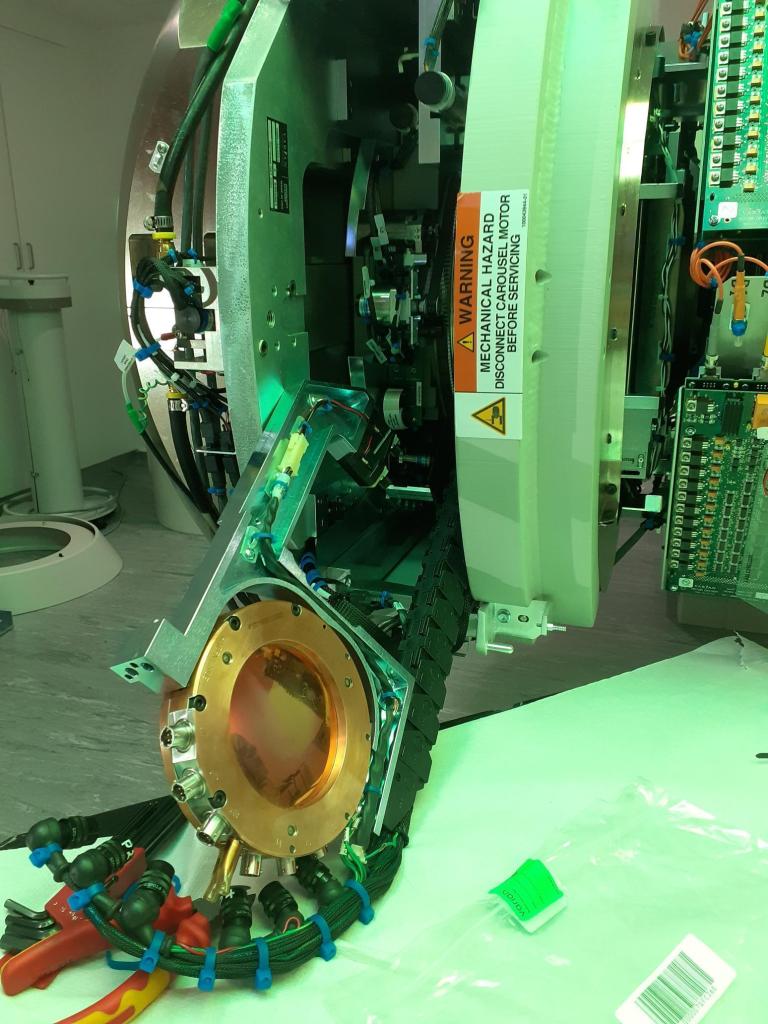
What is an ionisation chamber?
An ionisation chamber is a device that can measure absorbed radiation dose. Incoming radiation creates ion pairs in the sensitive volume of air. Electrodes gather these ions and a measurable current is generated across them. This current is proportional to the dose received.
Why do we have them in the Linac head?
The ionisation chambers in the LINAC head enable real time monitoring of output and beam symmetry during patient treatment and so are vital for quality control in radiotherapy.
Roles of the Linac head ionisation chambers?
• Ensure termination of radiation once required dose delivered.
• Monitor symmetry of beam.
• Display dose information for a minimum of 20 minutes in the event of failure of the supply mains or a component which causes interruption or termination of radiation.
Ionisation chamber interlocks?
Before each irradiation the system is tested to verify its capability to terminate the beam. This is a redundant dose monitoring combination so both ion chambers are tested. The CAL/CHK cycle is
used. CAL checks the calibration of integrators by forcing current through to produce an MU count. CHK tests the ability of the dose counters to terminate the radiation at a preset value. MU1 should terminate irradiation at the preset value whilst MU2 terminates at the value + the lesser of 10% or 0.25 Gy. If the CHK cycle is not successfully completed then an interlock will prevent treatment from commencing.
Beam asymmetry during delivery will cause an interlock to interrupt treatment. A measurement difference between the two chambers also creates an interlock.
Why are there 2 independent chambers?
In 1966, 3 patients received overdoses during electron therapy on a dual mode linear accelerator in the UK. The incidents occurred due to a rare beam current event and the failure of the single internal ion chamber simultaneously. Subsequently RASMP68 introduced the dual independent electrometer principle leading to the present day design of 2 independent linac monitor ion chambers. Their design must adhere to IEC 60601-2-1 standard.
My thoughts
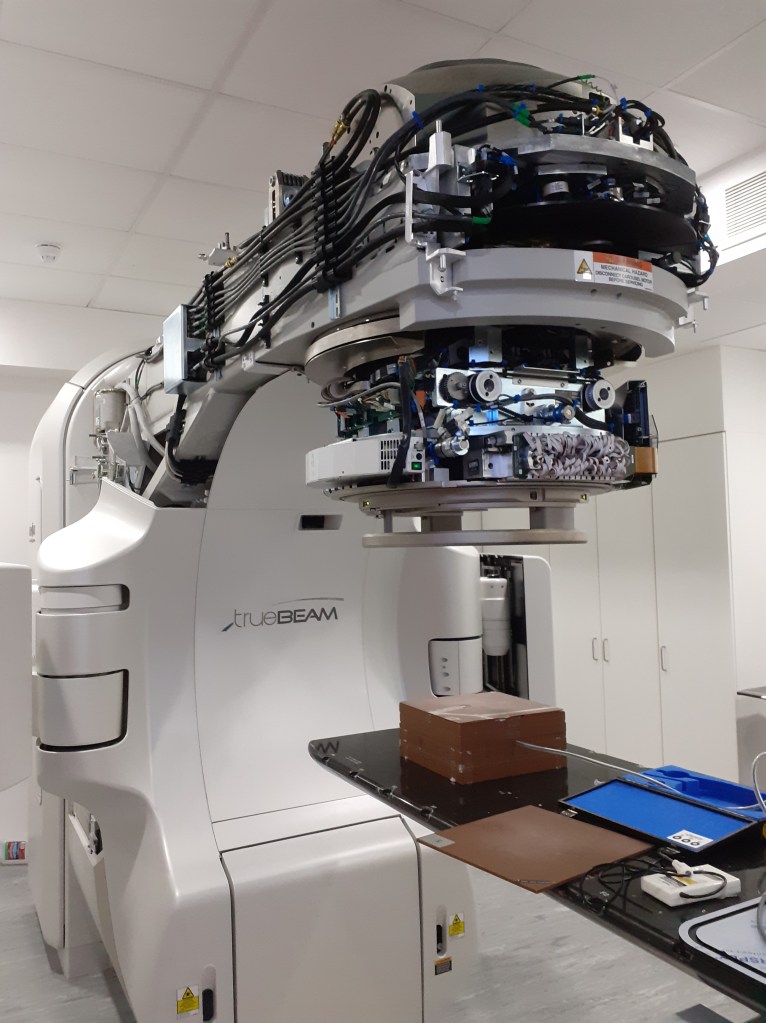
Getting to see the engineers do their thing and replace such an important part of our machine was very cool. I felt slightly out of place dressed in a lacy white flowery dress as the only woman, but more starkly, the only physicist in a room with 7 male engineers, but got to keep subverting those stereotypes right!
This session reintroduced the importance of open communication and teamwork and how hospital physics staff facilitate this between different staff groups (e.g. radiographers and engineers). The disparity in the approach of the Varian engineer and our engineering staff to diagnose a problem was also interesting to note.
In conclusion, physicists are great, open communication between teams is key and after seeing the LINAC in all its glory with the covers off, I am now even more in awe of their up time!
 "You're obviously not a scientist"